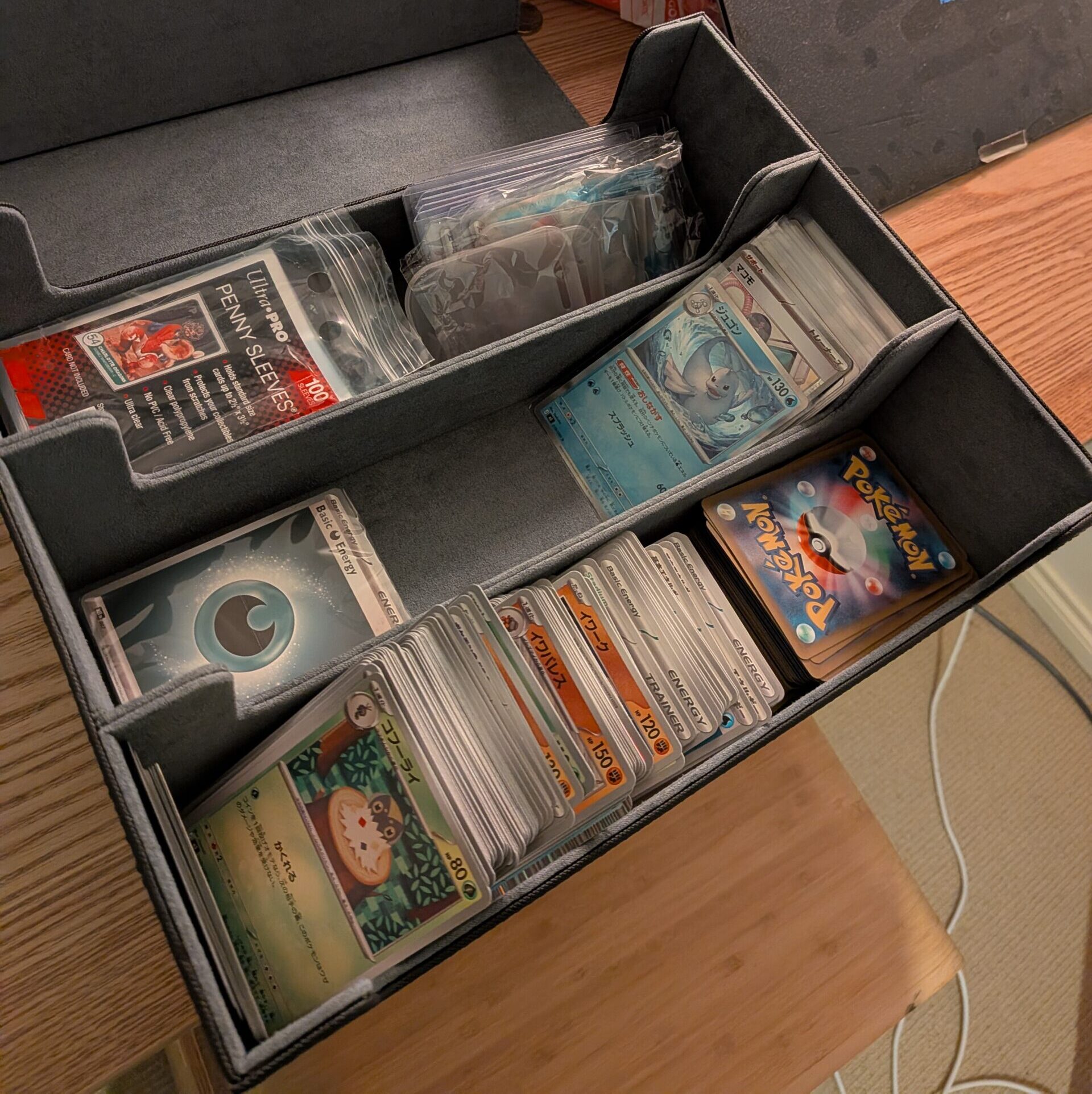
Pokémon card collectors often accumulate large amounts of low-value duplicate cards, commonly known as bulk. I explored whether this creates enough pain to justify a new product or service that helps collectors offload, donate, sell, or manage their bulk cards more easily.
The initial hypothesis was that collectors struggle with storage, sorting, low resale value, and difficulty finding places to donate cards. Through secondary research, Reddit comment analysis, web scraping, persona development, and recruitment planning, I found that bulk cards are not always experienced as a major problem. For many collectors, bulk is either accepted, stored, donated, or given away. However, there may still be an opportunity among collectors who delay action because they do not know what to do with their bulk, especially those with high card volumes and low willingness to sort manually.
| Field | Details |
| Role | Product discovery, user research, problem validation |
| Project type | PM case study |
| Research focus | Pokémon card bulk management |
| Methods | Reddit research, persona synthesis, assumption mapping, interview planning |
| Outcome | Original broad problem weakened; narrower opportunity identified around decision fatigue and high-volume collectors |
As a Pokémon card collector myself I always have looked at the growing pile of bulk and found that this is bound to be a problem for me at some point. After looking around online and noticing that it is a popular YouTube Video, eBay listing and Reddit Question - my research question turned into:
How might we reimagine getting rid of bulk Pokémon cards?
My primary assumption was that collectors who rip packs eventually accumulate large volumes of unwanted cards - especially when they’re ripping packs to chase for a certain card. These additional cards may take up space, require sorting before sale, be unprofitable to sell online due to shipping costs, or be difficult to donate because collectors may not know which schools, libraries, charities, or community groups accept them.
The initial hypotheses were:
| Assumption | Hypothesis |
| Bulk cards take up storage | Collectors with lots of bulk eventually run out of space as they go deeper into the hobby. |
| Selling to card stores requires sorting | Collectors experience friction because stores may require cards to be categorised first. |
| Selling online may not be worth it | Shipping costs and low card value can reduce the incentive to sell bulk online. |
| Donating takes effort | Collectors may struggle to find a place that wants or accepts bulk cards. |
The research goal was:
To understand the main pain points that collectors and stores experience when storing, selling, trading, or offloading bulk Pokémon cards.
The research objectives were to:
The early segmentation focused on people who wanted to:
The selected focus was people who want to get rid of bulk quickly, because speed and convenience appeared to be a clearer behavioural motivation than simply “having bulk.”
The main groups considered were:
| Segment | Why they matter |
| Pack-ripping collectors | They generate bulk frequently and may eventually need a way to clear space. |
| Collectors trying to profit from bulk | They may care about resale value, sorting, and sales channels. |
| Hobby card store owners | They may handle bulk at larger volumes and need efficient resale or storage workflows. |
| Stores with excess bulk | They may need better ways to bundle, donate, resell, or process low-value cards. |
At this stage, I assumed hobby stores would have a more obvious pain point because they buy and sell cards at scale. However, because they are businesses, they may already have established systems. That means a new product would need to be clearly more profitable or efficient than their current workflow.
To understand how collectors currently manage unwanted bulk Pokémon cards, I reviewed existing Reddit discussions, analysed responses from my own Reddit post, and scraped comments from related community threads.
Across my research, I reviewed 11 Reddit posts and 93 comments, while my own Reddit post received 132 replies. These sources helped identify recurring behaviours, frustrations, and attitudes around bulk cards.
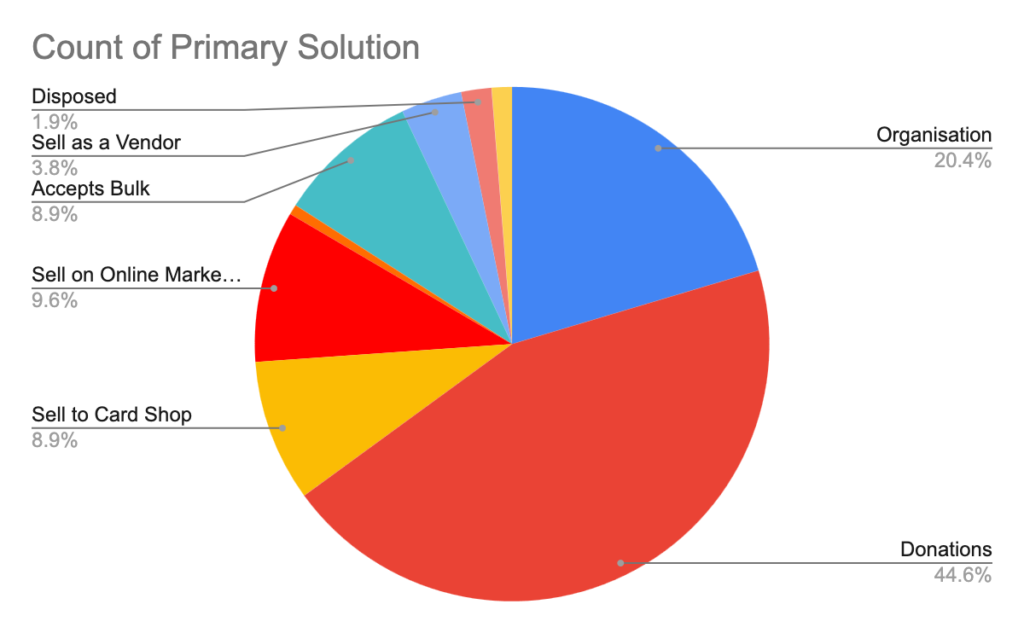
The findings showed that collectors generally manage bulk in a few common ways:
Overall, the research suggested that bulk cards are not automatically seen as a serious problem. Some collectors treat bulk as part of the hobby and enjoy organising or keeping it. Others prefer to donate cards because it feels easier and more meaningful than trying to make money from them. Selling is still a common option, but it involves trade-offs between speed, effort, and financial return.
A recruitment and discussion guide was created to qualify collectors based on three criteria:
| Criteria | Pass |
| Collector type | Pack ripper or mixed collector |
| Bulk volume | 500+ cards |
| Awareness of problem | Has thought about what to do with bulk |
This helped narrow the target group to collectors who were more likely to have experienced the problem directly.
This collector sees bulk cards as something that can still create joy for others, especially children, students, nieces, nephews, or people new to the hobby.
They are not primarily motivated by profit. They want to avoid waste and pass the enjoyment of Pokémon cards to someone else.
A donation finder or gift-pack builder could help this group prepare bulk cards for children, schools, libraries, or community organisations.
This collector does not see bulk as waste. They organise cards by set, artwork, artist, cuteness, or personal theme. For them, bulk can still have emotional or aesthetic value.
A sorting assistant or collection management tool could help them decide whether each card should be kept, bindered, traded, donated, sold, or recycled.
This collector knows they have too much bulk, but the problem is not urgent enough to solve immediately. Their cards sit in ETBs, drawers, boxes, or tubs until the issue becomes harder to ignore.
A tool or service could reduce decision fatigue by helping collectors answer:
“What should I do with this bulk based on how much I have, how much effort I want to spend, and whether I care more about money, space, or giving the cards away?”
Many collectors seem happy to donate or give away bulk cards. This suggests that a segment of users does not view bulk primarily as a financial asset. Instead, they see it as something that can create joy for others.
This is useful from a product perspective because it shows that the “sell my bulk” assumption may not apply to every collector. A donation-focused solution may be useful, but it may be harder to monetise.
Given that the most common option for offloading bulk would be to donate the cards to friends, family or to different local services indicates that donations is not a problem at all. While a product to improve this process could be explored this also would be difficult to monetise. With this finding, this disproves my assumption that donations are a pain point for offloading bulk - collectors have already solved this themselves.
Selling on online marketplaces may provide a higher return, but it can take longer and requires listing, waiting, communicating with buyers, and handling shipping.
Selling to a local card store may be faster, but collectors usually receive less money because stores need room to resell at a profit.
This suggests that collectors may choose different methods depending on whether they care more about:
Organising bulk was one of the most common outcomes in the research. This suggests that bulk cards do not automatically create pain if collectors have a storage system.
However, organisation may only be a temporary solution. Storage eventually has limits, and once collectors reach that point, offloading bulk quickly may become more important.
A major insight is that “having bulk” is not automatically a painful problem. Some collectors enjoy keeping bulk. Others donate it. Others store it and forget about it.
This weakens the original broad product idea.
The stronger opportunity is not:
“Collectors have bulk cards.”
It is more likely:
“Some high-volume collectors do not know the best way to turn unwanted bulk into space, value, or goodwill without wasting time.”
One respondent noted they actively seek out bulk cards to incorporate into their artwork — an early signal that a niche of collectors exists for whom commons and duplicates hold genuine creative value, whether for personal projects or an art-based business.
This points to a potential alternative demographic worth considering. However, the opportunity has profitability limitations - the respondent was specifically looking for cheap bulk, which narrows the margin for any would-be supplier. There is also a variety problem — available bulk tends to skew heavily toward modern sets, leaving little room to explore older or more eclectic cards. For this demographic, that lack of variety directly undermines the creative appeal that draws them to bulk in the first place.
Based on the findings, the assumptions created have been mostly confirmed but also signal a lack of urgency in collectors. The consensus is that most collectors are content with their bulk collection and have found a way to manage it in their own way - making this product opportunity weaker.
| Assumption | Hypothesis | Status | Evidence |
| Bulk cards take up storage | Collectors with lots of bulk eventually run out of space as they go deeper into the hobby | Partially confirmed | Organisation delays the pain — storage limits are real but not yet urgent for most collectors (Finding 3) |
| Selling to card stores requires sorting | Collectors experience friction because stores may require cards to be categorised first | Confirmed | Selling involves clear speed vs value trade-offs, with effort cited as a barrier (Finding 2) |
| Selling online may not be worth it | Shipping costs and low card value reduce the incentive to sell bulk online | Confirmed | Online selling provides higher returns but requires listing, shipping, and buyer communication — low perceived ROI (Finding 2) |
| Donating takes effort | Collectors may struggle to find a place that wants or accepts bulk cards | Disproved | Donation is the most common offloading method at 44.6% — collectors have already solved this themselves (Finding 1) |
Based on the findings, I decided to not build anything and abstained from proceeding with this product opportunity. There are opportunities for pivoting that could be of value and a product could be found upon further investigation. However, the input vs return of this research would be next to none and any additional research would be down to my own passions as opposed to following any opportunity for a profitable product.
Considering that the bulk cards don’t seem to be a problem for collectors, making a product here would be unwise. Potentially if we were to investigate further I could pivot into a deeper niche within this space.
At this stage, the strongest product decision is to avoid building until a sharper pain point is confirmed. The research so far suggests that casual collectors already have acceptable workarounds, even if those workarounds are not perfect. A more valuable next step would be to treat this as a discovery pivot - move away from “bulk cards are a problem for collectors” and investigate whether specific subgroups experience bulk as an operational, creative, or gameplay-related constraint. If one of these groups shows stronger urgency, repeated behaviour, or willingness to pay, then the opportunity can be reframed around that narrower use case instead of the broader collector market.
If this project were to proceed then the recommended starting point would be to begin reaching out to vendors or card store owners. They would typically have more pressing problems that can be solved and would be easier to monetise. With collectors in a B2C market, a decent size of the market that is content with their bulk and would look for free options to solve their problem which constrains opportunities for margin or payment.
This project helped me learn that a product idea can be personally interesting without being painful enough for a market. Within this case study, interviewees didn’t have the bandwidth for a full conversation and would much rather provide a simple answer, which in of itself revealed valuable data - but nothing concrete enough to justify a product.
The most valuable insight was that weak engagement and existing workarounds are not failures. They are product signals. If users already donate, store, or give away their bulk without much frustration, then the problem may not justify a standalone product.
However, the research also revealed a more specific opportunity - collectors who delay action because they do not know what to do with their bulk. For this group, the product opportunity may not be “selling bulk cards.” It may be reducing decision fatigue and helping collectors choose the best next step based on their goals.
The next stage of the project would be to validate whether this narrower segment experiences enough urgency to justify a prototype.